JOSEPH PALMER KNAPP
The final hours of the War Between
the States were recording some of its fiercest fighting and swift
sailing brigantines were still slicing through the water of the
East River on May 14,1864, when Joseph Palmer Knapp was born in
Brooklyn Heights, New York. Brooklyn was a prestigious address
in those glorious days. His mother Phoebe Palmer, a wealthy Chicagoan,
and his father, Joseph Fairchild Knapp, a well known business
man and financier. His parents were strict Methodists and Joseph
and his sister, Antoinette, regularly attended the Brooklyn Methodist
Church. His father was superintendent of the Sunday School for
forty years; his mother was the church organist, and a writer
of Methodist hymns.
While Mr. Knapp was attending Brooklyn Polytechnic Institute and Columbia University, his father was becoming a center of power in New York. He was company founder of Metropolitan Life Insurance Company, was owner of huge tracts of land, and was President of the Knapp Printing and Publishing Company. Mr. Knapp worked for his father for $5.00 a week, three of which he was expected to deposit in the collection plate each Sunday. Many years later, when Mr. Knapp had accumulated a large fortune, he asked his lawyer how much money he was worth. He answered, "Somewhere between ten and twelve million, not counting the Foundation." Mr. Knapp exclaimed, "God! How I wish my father could know that."
A man with aristocratic hearing and great vision, Mr. Knapp was not content with inherited wealth. In his own right he became a publisher of United Newspaper with Mr. James B. Duke of Durham, North Carolina; owner of America Lithograph Company, President of Crowell Collier and Publication Corporation. He ruled a vast publishing empire, one of the largest in the world. His idea that books would be read by a greater number of people if presented in a condensed form created what we know today as Reader's Digest . He was instrumental in developing a multicoloring press and a fast drying ink.
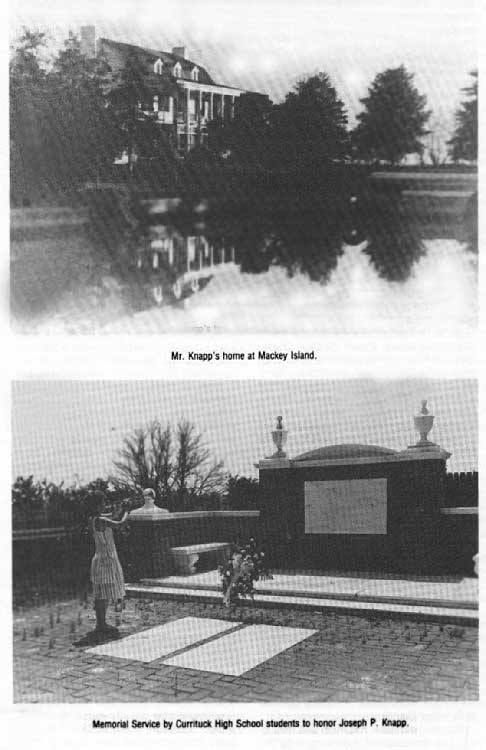
The editor of Field and Stream recommended Currituck Sound as the greatest duck hunting county on the Fast Coast. The raw winter exposure of the Atlantic brought thousands of ducks the north-south inner flyway over the sound. Returning home from a hunting trip in 1918, Mr. Knapp met Thomas Dixon, author of Birth of the Nation, aboard the Cape Charles ferry. Mr. Dixon related the glories of his small lodge called "Wildacres" on Mackey Island. Mr. Knapp negotiated at once to buy the 2500 acre "lodge" in 1919, a mansion resembling Mount Vernon with a nine hole golf course and a swimming pool. Russell Griggs of Hampton Lodge was his first guide and close friend. The small Dixon house and a red barn are all that remains of the beautiful estate.
The third marriage of Mr. Knapp in 1923 to Margaret Rutledge of Mississippi was an enduring one. They were married at Mackey Island. She was 39 years old; he was 20 years her senior. Mrs. R.E. West of Moyock was a guest at the ceremony. His only children, Joseph Fairchild and Claire, were born of his first marriage.
In the year 1918, Mr. Knapp was writing a series of articles for Colliers magazine on the need for a standard policy of education in the country. One cold, rainy day, driving to the Knotts Island post office, he offered a ride to some school children. He questioned them and found they attended a one room school without heat, lights or water; a one teacher school with a three month term. Thus began his interest, investigation and action on behalf of Currituck County. The reorganization, restaffing and rebuilding, plus thousands of dollars spent by this unpretentious, generous man for the education of the children of Currituck County is a bank in itself. He personally hired Miss Maud Newbury as the architect of his proposed model school system. Together they added an agricultural teacher, a music teacher, a home eco-nomics teacher, a school nurse, band instru-ments, and movie equipment. He build three teacherages complete with cooks and house-keepers, built and equipped a school at Knotts Island and Currituck. In 1925, Mrs. Knapp started the hot lunch program, with kitchens and lunch rooms.
Mr. Knapp never lost interest in his beloved Currituck Sound, or the welfare of the county people he considered his friends. With Mr. J. Cary, he had the locks built at Great Bridge to control the salinity of the water in the Sound. He originated the Currituck Exchange for the sale of farm products. He also founded Ducks Unlimited. His list of accomplishments and benovalences was vast.
It was indeed a cold January in 1951 for Currituck County when Joseph Palmer Knapp, aged eighty six, ended a lifetime of leadership, innovation and generosity. His life spanned one of the greatest periods in American History-- from sail to steam; horseback to automobile; railroads to airplanes. Lewis Dudley flew to New York and brought the urn containing the ashes of Mr. Knapp to Bagley Memorial Cemetery in Moyock. They are interred in a lovely setting, landscaped with camellias from Mackey Island by Dudley Bagley. Since a memorial service was held at St. Thomas in New York City, there was no formal service at the grave. Russell Griggs and Dudley Bagley, two old and trusted friends, simply lowered the urn in the vault. The body of his wife, Margaret Rutledge, has rested beside him since January, 1960.
Sources: Book by Dudley Bagley; remembrances of Mrs. Joseph
Knapp and Mr. and Mrs. Dudley Bagley. Bates, Jo Anna Heath, Ed.
The Heritage of Currituck County, North Carolina. The Albemarle
Genealogical Society, Inc., 1985.

